
The capillaries in the refrigeration circuit
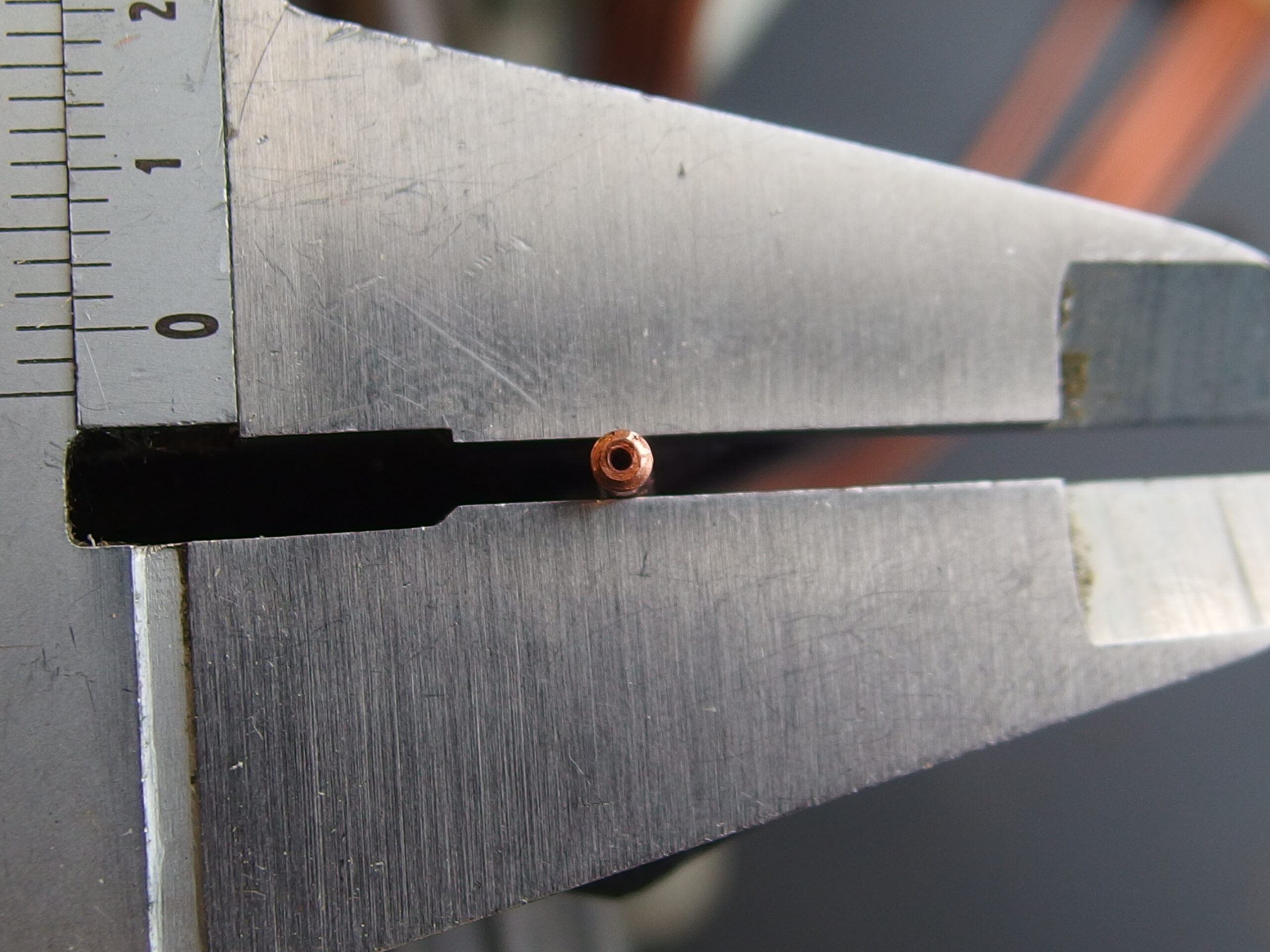
Usually several meters long and with an inner diameter of less than one millimeter, the capillary tube is one of the core components in the refrigeration circuit and just as important as the compressor – yet it is often underestimated.
The capillary in the refrigeration circuit
Usually several meters long and with an inner diameter of less than one millimeter, the capillary tube is one of the core components in the refrigeration circuit and just as important as the compressor – yet it is often underestimated. It boasts a number of attractive features: the tube is inexpensive, operates passively, is robust, and is easily reproducible. Due to its pressure drop, it simply adjusts the evaporation temperature and refrigerant mass flow in the refrigeration cycle. But how is this component correctly designed and specified?
The compressor – complex, but easy to map
Let’s start with the compressor, which consists of a large number of mechanically moving parts. Its job is to drive the refrigeration cycle by circulating the refrigerant. Its performance can be illustrated either by the manufacturer’s data sheet or by data collected from a test bench. This information can be used to create relatively simple models for design purposes.
Capillaries – valuable, but difficult to grasp
The compressor requires a counterpart. This is where the throttling device comes into play, as it is this device that enables the refrigeration circuit to be started up. The capillary tube is the simplest type of throttling device. It has no moving parts and acts passively.
The process that takes place in it can be imagined as follows: The refrigerant enters the pipe in liquid form, and a pressure drop occurs in the direction of flow. This causes the refrigerant to eventually enter the two-phase dome, which means that it begins to boil. This triggers a self-reinforcing process: gas bubbles form, which accelerate the flow velocity and thus lead to a further and greater pressure drop. This in turn causes the formation of gas bubbles to increase further. This process only ends when the refrigerant exits the capillary.
The big challenge now is to map this physical process in a practical and reliable way. There is no universal formula for this.
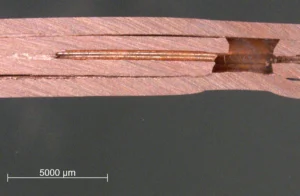
Micrograph of a connection between two capillary ends
Tricky starting position
If you want to calculate this change in state, you quickly find yourself confronted with topics such as the Fanno curve, supersonic flows, flow regimes, and their changes. And that’s without even considering the circulating oil. There are a few empirical and semi-empirical models that are quite useful for certain initial conditions, but they become invalid as soon as the framework conditions change. And if an internal heat exchanger has also been integrated, which is the case in most refrigeration circuits, every model fails with its calculation.
“The length and inner diameter are known – so no problem at all?”
Specifying a capillary requires a great deal of tact, experience, and expertise. Even if the length and diameter of the capillary are known, this does not automatically guarantee process reliability. This is because throttle capillaries are specified with the nitrogen volume flow rate that occurs at a defined pressure difference. It is essential that developers and suppliers have the same understanding in this regard.
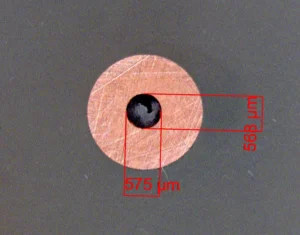
Checking the inner diameter
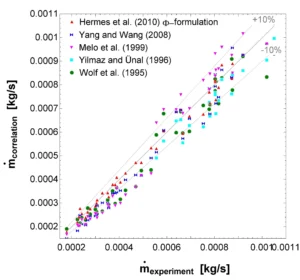
Comparison of correlations for capillary flow rates with R600a based on measurement data from Melo et al. (1999) and Schenk and Oellrich (2014)
Source reference
-
Melo, C., Ferreira, R.T.S., Boabaid Neto, C., Gonc¸alves, J.M., Mezavila, M.M., 1999. An experimental analysis of adiabatic capillary tubes. Appl. Therm. Eng. 19, 669-684.
-
Hermes, C.J.L., Melo, C., Knabben, F.T., 2010. Algebraic solution of capillary tube flows Part I: adiabatic capillary tubes. Appl.Therm. Eng. 30, 449-457.
-
Yilmaz, T., U¨ nal, S., 1996. General equation for the design of capillary tubes. ASME J. Fluids Eng. 118, 150-154.
-
Yang, L., Wang, W., 2008. A generalized correlation for the characteristics of adiabatic capillary tubes. Int. J. Refrigeration 31, 197-203.
-
Schenk M., Oellrich L.R., 2014, Experimental investigation of the refrigerant flow of isobutane (R600a) through adiabatic capillary tubes, Int. J. Refrigeration 38, 275-280
-
D.A. Wolf, R.R. Bittle, M.B. Pate, Adiabatic capillary tube performance with alternative refrigerants, ASHRAE Res. Project RP-762 (1995).
Cool solutions for hot results.
We always step in when thermally complex, sustainable, and market-ready solutions are needed.


